CRM Pricing Teardown: Who Wins, Who Doesn't.
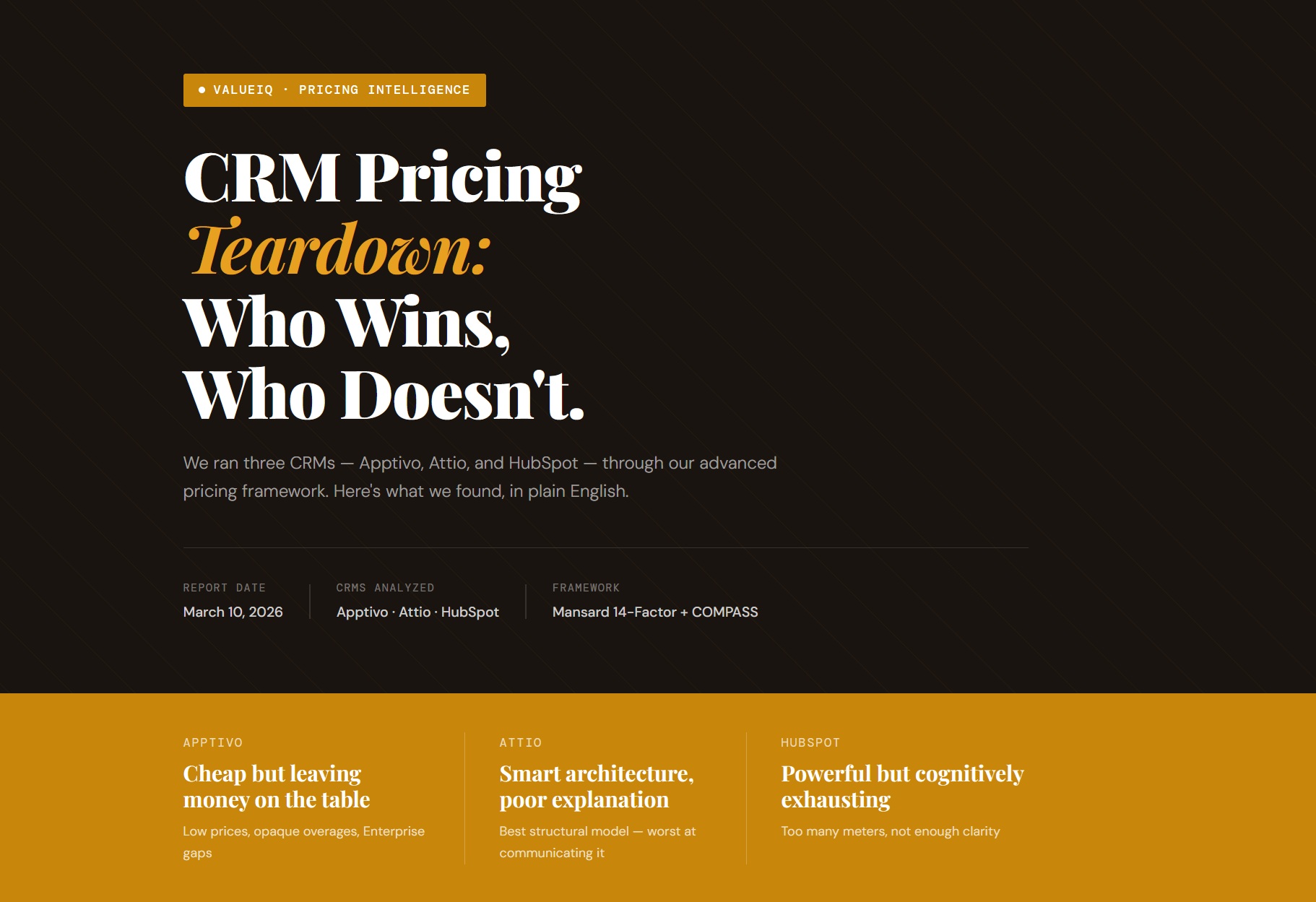
Pricing is one of the most powerful levers a software company has — and most get it wrong. Not because they charge too much or too little, but because they make it unnecessarily hard for buyers to understand what they're actually paying for.
We put three CRMs through our advanced pricing strategy framework: Apptivo (the budget-friendly all-in-one), Attio (the AI-native challenger), and HubSpot (the established platform). What came back was a masterclass in how the same underlying mistakes — opaque usage limits, unclear overages, undocumented enterprise economics — show up differently at every price point.
Here's the full breakdown. No jargon required.
billed annually
billed annually
billed annually
bands or floors
- Cheapest published prices in the SMB CRM market — well below HubSpot and comparable to Zoho's entry tiers
- Genuinely broad: CRM + projects + invoicing + supply chain, all under one per-seat fee
- Simple four-tier ladder, no minimum contracts, cancel any time
- Natural upsell path from Lite all the way to Enterprise
- Overage rules for email, API calls, and storage are completely undocumented — buyers literally cannot forecast their bill
- Enterprise pricing has zero published floors or bands, leading to inconsistent deals and margin erosion
- The trial is locked to the Ultimate tier, which can feel like a push toward the most expensive self-serve option
- Low prices mask genuine value — heavy users on ops-heavy workflows are massively under-charged, which hurts Apptivo more than the customer
Apptivo's biggest challenge is one of its own making: it delivers far more value than it charges for, particularly for operations-heavy businesses that use it across CRM, projects, invoicing, and supply chain. The problem isn't the pricing structure — four tiers, per seat, linear pricing — that part is fine. The problem is everything that happens at the edges.
When a buyer hits their email sending limit or maxes out their API calls, what happens? Apptivo doesn't say. That ambiguity might seem harmless, but in 2026, buyers are scrutinising total cost of ownership obsessively. A company that can't tell you what happens when you go over your limit is a company you hesitate to trust with your entire business operations stack.
The opportunity here is significant: by simply publishing clear overage rules and introducing internal Enterprise price bands, Apptivo could realistically capture 5–15% more margin from its existing customer base without touching a single list price. That's not a small number.
The bottom line: Apptivo is the best deal in SMB CRM, but it's leaving real money on the table — and creating unnecessary anxiety — by refusing to tell customers what happens when they use the product heavily.
3 objects
billed annually
billed annually
custom credits
- The hybrid seat + credit model is genuinely clever — it lets you price both the number of users AND how intensively they use AI features
- Strong AI capabilities baked in at every tier, not locked behind expensive add-ons
- Free tier is generous enough to be a real product, not a demo — drives organic growth
- Clear natural expansion path from Free → Plus → Pro → Enterprise with meaningful jumps in value at each step
- Measurability is the highest of any vendor analysed: seats, credits, records, emails — all fully trackable
- "Seat credits" vs "workspace credits" — two different credit pools that behave differently. Almost no buyers can explain the difference
- Overage and rollover rules for credits: completely undisclosed
- Enterprise has no published minimums, seat floors, or credit bands — exactly the same problem as Apptivo, just at a higher price point
- No ROI model or outcome benchmarks to justify mid-to-premium pricing vs simpler alternatives like Pipedrive
Attio built something structurally impressive. The decision to price on both seats (how many people use the tool) and credits (how intensely they use AI and automations) is forward-thinking. In a world where AI usage is exploding and consuming real infrastructure costs, that's the right call. The problem? They've built a Ferrari and given buyers the user manual for a bicycle.
The core risk for Attio is a perception problem, not a pricing problem. A competitor pitching to the same customer can simply say: "We charge $X per seat, simple." Attio's response requires explaining seat credits, workspace credits, credit add-on packs, and rollover behaviour — none of which is publicly documented. That's a losing conversation in an evaluation.
What's particularly frustrating is how close Attio is to getting this right. The architecture is sound. The AI depth is real. The free tier generates genuine top-of-funnel momentum. If they published a plain-language credit explainer, defined what happens at quota exhaustion, and created an Enterprise playbook with floor pricing, the model would be arguably best-in-class.
The bottom line: Attio has the most sophisticated pricing architecture of the three, but sophistication without communication is just complexity. They need to explain their model the way you'd explain it to a smart friend over lunch — not the way an engineer would document it.
basic tools
1,000 contacts
3 core seats
5 core seats
- Marketing contacts + email sends as the primary value metric is genuinely well-aligned: as your marketing scales, so does what you pay
- Four-tier ladder maps cleanly to customer maturity — Free, Starter, Professional, Enterprise is an intuitive journey
- Strong net revenue retention architecture: growth in contacts, channels, and teams naturally pulls customers upward
- Measurability scores highest of all three vendors: every meter (seats, contacts, sends, workflows, credits) is software-tracked
- Five simultaneous pricing meters (account + seats + contacts + credits + onboarding) is cognitively brutal for buyers trying to model their spend
- HubSpot Credits — the AI usage currency — have no public rate card. Finance teams at Professional and Enterprise customers literally cannot budget for AI line items
- Mandatory onboarding fees ($3,000–$7,000) feel punitive rather than valuable, creating friction precisely when a customer is most ready to commit
- Starter pricing ambiguity between promo and "was" prices makes year-one spend impossible to forecast for small teams
- Scores 2/5 on structural simplicity — the lowest of the three vendors
HubSpot is the paradox of this analysis. It scores the highest on measurability and monetisation potential, and its fundamental logic — charge based on how many marketing contacts you manage — is probably the most defensible value metric of the three. And yet it also scores the lowest on simplicity and buyer effort, meaning the tool that should be easiest to justify is often the hardest to buy.
The HubSpot Credits problem deserves its own spotlight. As AI usage inside marketing platforms accelerates, credits will go from an interesting line item to a significant portion of a customer's bill. Right now, there's no public rate card — no table showing which AI features cost how many credits, no admin dashboard with burn alerts. For a mid-market CFO reviewing software spend, that's a red flag.
The most interesting challenge is the Starter tier. The price point is right. The features are good. But overlapping promotional prices and "was" prices, combined with unclear billing cadence differences, make it genuinely hard for a small business to know what they'll pay in month one. In a world where Mailchimp offers a near-identical entry point with cleaner economics, that confusion is costing HubSpot conversions.
The bottom line: HubSpot has the strongest value spine of the three vendors and the most durable expansion economics. But it's built pricing pages that make buying feel like filing a tax return. The fix is communication and tooling, not structural change — and that's actually good news.
Who Takes the Crown?
Every single CRM in this analysis fails at the same thing: telling buyers what happens when they use the product heavily. Overage rules, rollover behaviour, Enterprise pricing floors — all three are silent on the mechanics that matter most to buyers actually trying to budget. This isn't a pricing problem. It's a communication problem. And it's costing all three vendors real revenue.
These reports are generated by valueIQ — our advanced pricing strategy platform that analyses CRM and SaaS pricing models using the Mansard 14-Factor COMPASS framework. Every finding is grounded in publicly observed data, and every recommendation comes with confidence levels and kill criteria.
Want your pricing put through the same lens? We cover the full competitive landscape across CRM, sales, and marketing tech.
Stay ahead in value-based pricing
Get insights on pricing strategy, value selling, and customer value management — delivered to your inbox.
No spam. Unsubscribe anytime.