Pricing Page Teardown: Relevance AI

 In these teardowns, we use the valueIQ Pricing Intelligence agent to look at the pricing pages of well-known companies to see what we can learn, as well as look into pricing reviews that your team can actually use.
Previous pricing page teardowns include:
Relevance AI (this post)
You can get the Advanced Report on the Relevance AI pricing page by going to the Pricing Intelligence Agent, signing up, and searching for Relevance AI. The free plan gives you 200 credits per month, so you can download the Advanced Report for Relevance AI (Advanced Reports cost 120 credits, Standard Reports cost 30 credits).
Analyze a Competitor's Pricing — Free
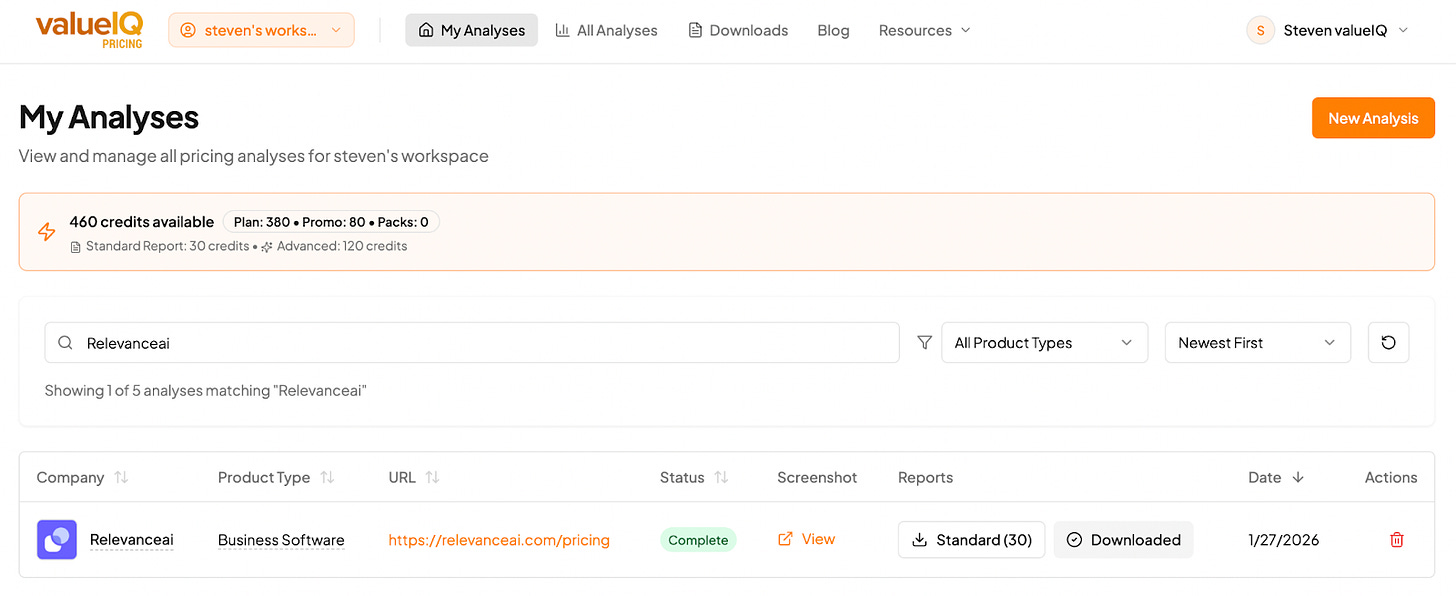 We generate the report by running Relevance AI’s pricing page through the Pricing Intelligence agent. It calls a number of sub-agents that work together to build a deep understanding of Relevance AI’s pricing, as shown by its pricing page, in a broader context.
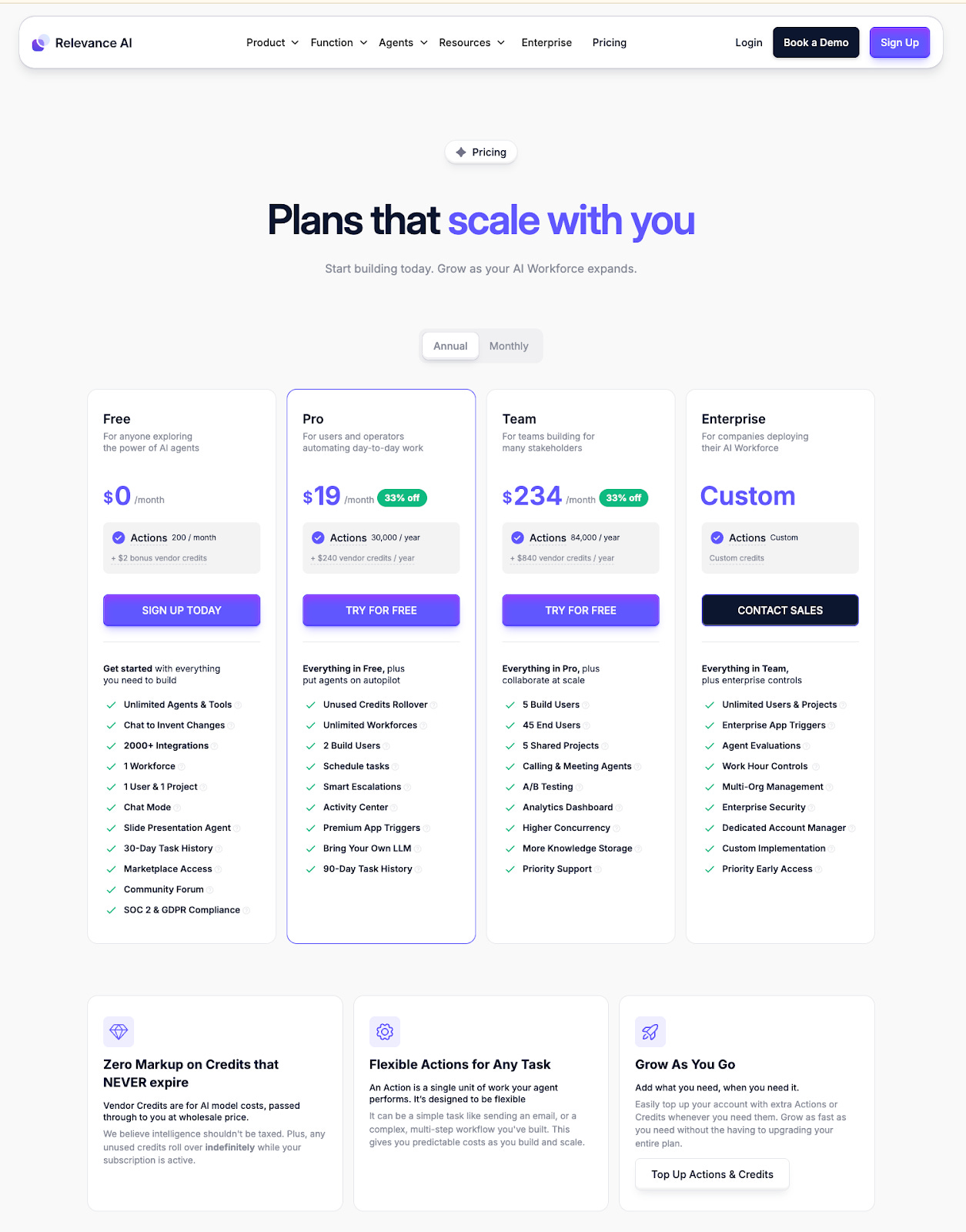 Why Relevance AI?
Relevance AI is interesting because it sits at the intersection of three big trends: AI agents, no‑code enterprise tooling, and outcome‑oriented automation. All of these have implications for pricing.
Relevance AI is building an “AI workforce” platform rather than a single bot or point tool. That means companies can create teams of AI agents, each with tools and roles, and orchestrate them as a multi‑agent system across many workflows and departments. This is a structurally different bet from traditional RPA or chatbots, and it aligns with how work is actually split across teams.
The platform is low‑code/no‑code and aimed at operators, not just engineers. Ops, RevOps, support, and marketing teams can design and manage agents visually, which makes advanced automation accessible to a far larger set of users inside an organization. That dramatically increases its potential adoption surface if the product is executed well.
The vision is to deliver “human‑quality work” on business‑critical workflows, not just toy use cases. It focuses on tasks like sales outreach, support, reporting, and back‑office operations, where measurable efficiency and revenue impact are large and recurring. This positions Relevance AI in high‑value parts of the stack where customers will pay for reliability, governance, and scale.
They have meaningful traction and capital for a relatively young category. Relevance AI has raised a substantial Series B led by tier‑one investors and reports strong agent creation and usage metrics on the platform. That funding and early traction give it a real chance to shape standards in agentic AI rather than just follow them.
Finally, its architecture and roadmap show a clear focus on enterprise readiness. It integrates with existing tools, supports bring‑your‑own models on infrastructure like AWS, and emphasizes governance, observability, and workload control so large organizations can trust agentic systems in production. If AI agents become a mainstream way to deliver work, a platform that combines this kind of control with no‑code flexibility is likely to be strategically important.
These strengths carry over into their pricing design options.
Pricing SWOT for Relevance AI
For an in-depth analysis with information on competitive positioning, value, and a detailed assessment using the Michael Mansard COMPASS methodology, get the report from the Pricing Intelligence Agent. A free subscription will cover this, and only a valid e-mail address is needed (no C/C).
The Advanced Report gives you the deeper cut.
See the Table of Contents for the Advanced Report for everything that you get.
- Internal: Strengths
- Dual meters (Actions + Credits) tightly track automated work and AI compute
- Vendor Credits roll over while subscribed; no markup on AI usage
- Clear, intuitive Action examples (email, CRM update, workflow) aid value storytelling
- Tier ladder (Free → Pro → Team → Enterprise) maps logically to team size and governance needs
- Internal: Weaknesses
- Action overage and rollover policies are not documented, blocking precise TCO modeling
- Dual meters and storage add‑on increase cognitive load vs single‑meter competitors
- Category: Weaknesses – Item: Extra Knowledge Storage cadence and base included storage are unclear (Observed). Segment Focus: Data‑heavy SMB/mid‑market/enterprise.
- Category: Weaknesses – Item: Enterprise pricing is fully bespoke with no public bands or examples (Observed). Segment Focus: Enterprise.
- External: Opportunities
- Category: Opportunities – Item: Own the “most transparent and fair agent platform” position via clear policies and fairness narrative (Modeled). Segment Focus: Mid‑market, Enterprise.
- Category: Opportunities – Item: Introduce micro‑add‑ons and semi‑standard Enterprise frameworks to unlock smoother expansion (Modeled). Segment Focus: Team & Enterprise.
- Category: Opportunities – Item: Add light outcome‑linked constructs on top of Actions/Credits for select enterprise workflows (Modeled). Segment Focus: Enterprise.
- External: Threats
- Category: Threats – Item: Simpler single‑meter competitors (credits/tasks) may win deals on perceived simplicity (Modeled). Segment Focus: SMB & mid‑market.
- Category: Threats – Item: Suite vendors bundling automation and agents under constant standalone tools on price and inertia (Modeled). Segment Focus: Enterprise.
- Category: Threats – Item: Mis‑tuned overage policy could either constrain usage (too strict) or create bill shock (too loose) (Modeled). Segment Focus: All paid tiers.
Pricing at other similar companies
- Gumloop – AI‑native workflow/agent platform using per‑workspace subscriptions plus credit buckets as the main meter (credits cover tasks and compute).
- Lindy – AI‑native agent platform with per‑workspace subscriptions plus credits and optional top‑ups.
- Zapier – General automation tool (low AI‑native depth) with per‑account subscriptions, task allowances, and automatic per‑task overages.
- Microsoft Power Automate – Suite‑bundled automation with per‑user/per‑bot subscriptions plus optional per‑run pay‑as‑you‑go charges.
Table of Contents for the Advanced Report
Part 1: Snapshot of Current State of Pricing
Part 2: Strategic Imperative.
2a. Strategic Imperative
2b. Market Shift
2c. Pricing Gap / Value Capture
Part 3: Value Architecture.
3a. How Value is Created
3b. Current Value Capture / Misalignment
3c. COMPASS Assessment .
Part 4: Pricing Framework and Competitive Positioning
4a. Tier Strategy & Positioning
4b. Competitive Positioning Map
Part 5: Pricing SWOT.
Appendices.
Appendix 1: Mansard 14-Factor Assessment
Appendix 2: Value Model (EVE) Summary
Appendix 3: Value Capture by Segment & Use Case
Appendix 4: Pricing Model & Price Curves
Not sure where your own pricing is drifting into? Pricing Intelligence will auto‑classify your page and show you where you sit – free, with 200 monthly credits to play with.
Stay ahead in value-based pricing
Get insights on pricing strategy, value selling, and customer value management — delivered to your inbox.
No spam. Unsubscribe anytime.