What Makes a Good Pricing Page?
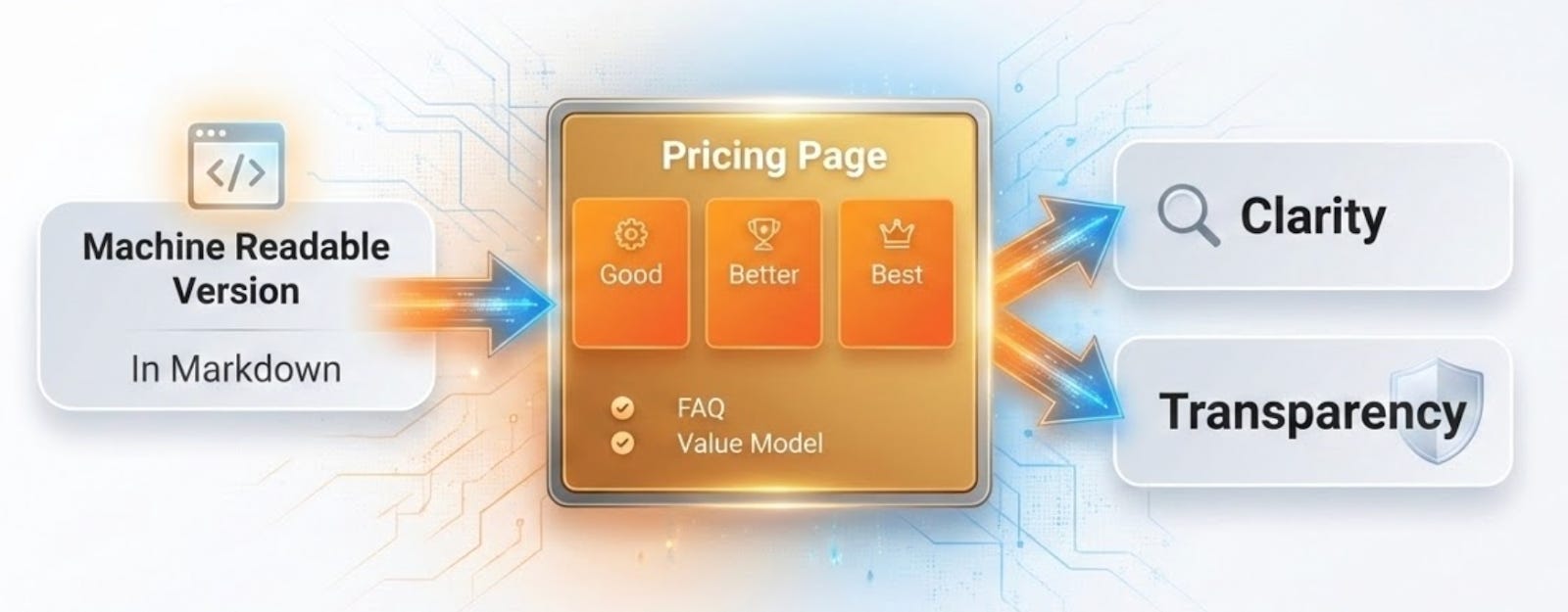
The first place people see your pricing is your pricing page. What should it tell them?
valueIQ's Pricing Intelligence Agent can help you answer this question.
Check it out here to get a free subscription with 200 credits per month. You can use these credits to get as many as 6 Standard Reports (30 credits each) or 1 Advanced Report (120 credits) and 2 Standard Reports.
A good pricing page is transparent about pricing, it answers the buyers (and the AIs) key questions, and it also provides clarity on value.
Pricing pages that default to "Contact Sales" will not work in 2026.
This alienates buyers who will immediately go somewhere else, where the information they need is available. It also blocks AIs from understanding your pricing, and when that happens they will either go elsewhere or hallucinate.
Not what you want.
In 2026 a good pricing page is clear, transparent about pricing and machine readable.
Clarity (your pricing page is also your value page)
The pricing page needs to be clear. This means that a viewer can easily answer the key questions noted above around both price and value.
Price:
- What are my buying options?
- Which option is right for me?
- What value will I get from each option?
- How can I move from one option to another (and back)?
- How much will this cost?
Value:
- Who does this create value for (do I recognize myself)?
- How does it create value (is this value I need and care about)?
- How much value will it create? (is the value fair given the price?)
The best way to explain value is to embed a value model in the pricing page.
Clarity is not just about the information provided. Design is also important. The page needs to be designed using a clear grid and have a visual hierarchy. The design should guide the eye and hand (or thumb for the many people who will be viewing the page on mobile) along the lines of attention and thought.
Think of your pricing page as a mini application that helps people (and AIs) answer their questions about pricing. It is not bait to get people to contact sales.
Transparency (tell people what they need to know)
There are actually two types of pricing transparency: price and pricing process.
Price Transparency: Your actual prices are publicly available. Product Led Growth (PLG) companies typically must have price transparency, most sales led growth companies do not.
Pricing Process Transparency: the process used to set prices (such as cost plus, or pricing relative to a market standard, or value based pricing)
One of the long standing debates in pricing is whether pricing should be transparent. There is a growing consensus among pricing experts that transparency wins, especially in an age of AI.
The front end of the buying process is owned by AI and if an AI cannot find the information it needs it may well invent it (hallucinate). If AIs are hallucinating about your pricing it is your fault. You have not provided the information they need.
Make prices transparent if:
- You have compelling differentiation
- You are a commodity
- Buyers are using AI in their buying process
Make your pricing process transparent if:
- Understanding how you price communicates how you deliver value
- Price is highly context dependent and there are too many combinations to give a simple price
- Buyers are using AI in their buying process
Keep your pricing secret if:
- You lack confidence in your pricing
- You are scared of the competition
- Your value proposition is obscure
Machine Readable
AIs are looking at your pricing page and extracting information from it.
This includes the robots that collect data to train the major foundation models like OpenAI's GPT, Google Gemini and more specialized solutions like Sakana, Cohere and Mistral.
It also includes the search AIs like Perplexity that are increasingly used in the buying process. Your potential buyers are asking their AI chatbots about your pricing. Specialist buying or purchasing agents are emerging that are also looking at your pricing page and comparing you with your competitors.
We are seeing more and more pricing pages that have an AI optimized version. Generally these versions are not visible to human users but are easy for the AI to find. They are formatted as markup. The goals for the AI readable pricing page are:
- Structural Clarity: Markup helps define the document's structure
- Semantic Meaning: It adds explicit semantic meaning to elements
- Instruction to the Model: Markup can include direct instructions guiding the AI
- Improved Output: Well-structured content produces more accurate AI outputs
The valueIQ Pricing Intelligence Agent
Want to improve your pricing page? Try the valueIQ Pricing Intelligence Agent. You can do a lot with the 200 monthly credits that are part of the Free tier.
The table of contents for an Advanced Pricing Page Report looks like this:
Part 1: Snapshot of Current State of Pricing
Part 2: Strategic Imperative
- 2a. Strategic Imperative
- 2b. Market Shift
- 2c. Pricing Gap / Value Capture
Part 3: Value Architecture
- 3a. How Value is Created
- 3b. Current Value Capture / Misalignment
- 3c. COMPASS Assessment
Part 4: Pricing Framework and Competitive Positioning
- 4a. Tier Strategy & Positioning
- 4b. Competitive Positioning Map
Part 5: Pricing SWOT (Strengths Weaknesses Opportunities Threats)
Appendices:
- Appendix 1: Mansard 14-Factor Assessment
- Appendix 2: Value Model (EVE) Summary
- Appendix 3: Value Capture by Segment & Use Case
- Appendix 4: Pricing Model & Price Curves
Stay ahead in value-based pricing
Get insights on pricing strategy, value selling, and customer value management — delivered to your inbox.
No spam. Unsubscribe anytime.