Pricing Page Parts
Your pricing page is one of the most important pages on your website.
It is about more than price.
It is where you have the opportunity to:
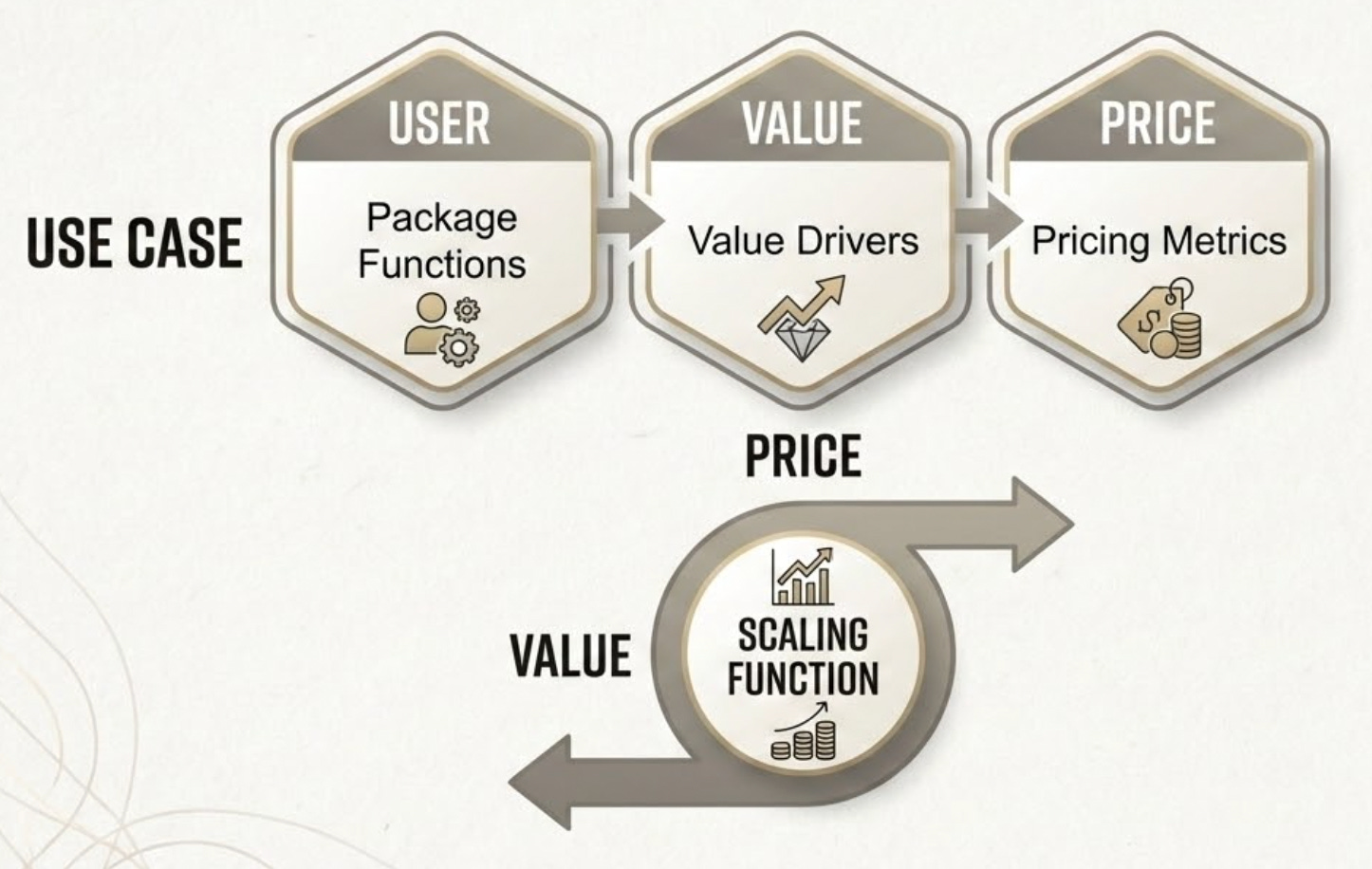
- connect use case with value with price
- to answer buyer questions about the different packages and options you offer
- to explain how they will be paying and how much they will be paying
- along with what their options are
A good pricing page makes it easy for the buyer to answer all these questions.
It reinforces this with proof.
The best form of proof is a validated value model. Your pricing model and your value model should be connected at the hip (or more accurately, be connected through shared variables).
The social proof can be comments from people about the value they have received, but it can also be linked to sites such as G2 and Capterra.
There is something deeply frustrating about something called a pricing page that does not answer basic questions about pricing.
When a company says it has a pricing page and all the pricing page does is say to "CONTACT SALES," does it really have a pricing page? The valueIQ agent says no and declines to analyse pricing pages that do not have any actual pricing.
Standard Pricing Page Patterns
A few standard patterns have emerged for pricing pages, generally reflecting the underlying packaging pattern rather than the price. These can be combined, but you can generally see the dominant pattern at a glance.
Good Better Best (GBB) or Tiered Pricing
This is most often used with product-led growth (PLG). It has been heavily promoted by pricing consultants and is often used, or misused, where it does not make much sense. We also see many anti-patterns here. The most common is to have just two tiers, thereby missing the framing power of GBB and the upsell opportunities.
The Pricing Table
The second most common pricing page pattern is the pricing table, which is mostly used for modular packaging or, in some cases, the platform + extensions packaging pattern.
Here, it is critical to have a pricing metric or metrics that align with value. One way to do this is to have an explicit value metric and a pricing metric and to make sure that they scale in the same way so that value > price across scale.
Value Metric: The unit of consumption by which a user gets value.
Pricing Metric: The unit of consumption for which a buyer pays.
The Pricing Estimator
In some cases, it makes more sense to provide the buyer with a pricing estimator or calculator. Here, the buyer makes a selection, enters a few variables, and is presented with a price.
The best practice here is to provide a good guide, maybe a decision tree, to help the buyer select the right package for their needs.
The Underlying Structure
Underlying all of these patterns is a deep structure that connects the user and use case to the value and price that does the math to calculate how value and price change with scale.
- There is a package for each use case and user
- The value of the package is clear
- The pricing of the package is clear
- It is clear how price and value change with scale
- Scale can be: Number of users, Degree of use, Access to scale
- Functions can be included or priced separately
Pricing Page Checklist
Make sure your pricing page includes the following:
☐ Each package/offer is clearly defined
☐ The packages/offers are mapped to use cases
☐ There is guidance on which package/offer is best for the user
☐ The value of the package/offer is clear and predictable
☐ The price of the package/offer is clear and predictable
☐ The relationship value > price holds across scale
Use the following prompt to test your pricing page
We recommend doing this with ChatGPT, Gemini, and Perplexity:
"Act as a buyer of B2B software. Your job is to evaluate the pricing as presented in the pricing page. Go to [pricing page URL] and answer the following questions:
What packages are available? What is included in each package? What is the use case for each package? Who is the intended user of each package? What is the price of each package? How does the price of each package change with the number of users, the level of use, the capacity available? What is the value of each package? How does the value of each package change with the number of users, the level of use, the capacity available? Is this pricing model favorable to a buyer?"
The valueIQ Pricing Intelligence Agent uses an advanced version of this prompt, plus additional prompts, across five different sub-agents to generate its reports. Sign up to get 200 free credits per month that you can use to get an Advanced Report or as many as six Standard Reports.
Stay ahead in value-based pricing
Get insights on pricing strategy, value selling, and customer value management — delivered to your inbox.
No spam. Unsubscribe anytime.