Why bother with a pricing SWOT?
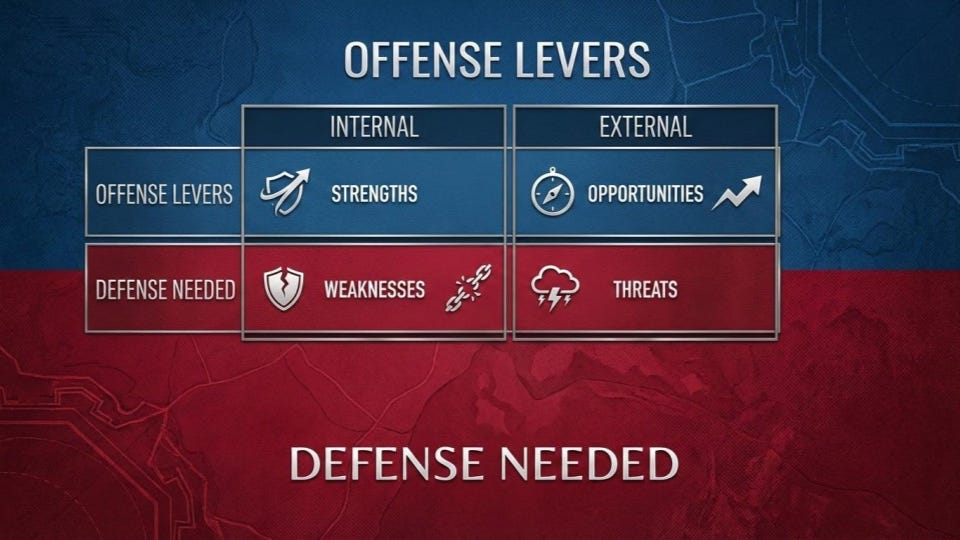
The valueIQ Pricing Intelligence Agent includes a full Pricing SWOT in its Advanced Report.
A conventional SWOT covers an organization's Strengths, Weakness, Opportunities and Threats.
Strengths and weaknesses are the internal view.
Opportunities and threats are the external view.
These are sometimes recombined into a strategic SWOT where strengths are paired with opportunities and weaknesses with threats.
A Pricing SWOT applies the SWOT framework to a company's pricing. It is a critical tool used by pricing consultants to help decide where to focus pricing work. One wants to use strengths to take advantage of opportunities and to be aware of the weaknesses that competitors can threaten and exploit.
What are some of the things that come out as strengths, weaknesses, opportunities, and threats in the AI analysis of a pricing page?
The best way to see this is to sign up for the valueIQ Pricing Intelligence Agent and download an advanced report.
Strengths: Internal Capabilities That Enable Value Capture
Strengths in B2B SaaS pricing represent structural and strategic advantages that allow your organization to command premium prices, reduce sales friction, and scale efficiently. These capabilities emerge from deliberate architectural choices, organizational competencies, and market positioning.
Value Metric Alignment with Customer Outcomes
Description: Your pricing model directly correlates with how customers derive and measure value from your solution, creating intuitive scaling that feels fair to both parties.
Why It's a Strength: When value metrics align with customer success, pricing becomes self-explanatory and justifiable. Tom Nagle's Economic Value Estimation framework demonstrates that customers willingly pay for solutions where they can clearly quantify the return. This alignment reduces sales friction, enables natural expansion, and creates pricing that scales proportionally with customer growth.
Differentiated Value Proposition with Economic Quantification
Description: Your solution delivers measurable economic benefits relative to competitive alternatives, and you've systematically documented this differentiation through Economic Value Estimation (EVE) models.
Why It's a Strength: Research demonstrates that companies excelling at value communication achieve 15-20% price premiums over competitors with similar products but inferior value articulation. When sales teams can quantify customer-specific ROI using concrete value drivers—cost reduction, revenue enhancement, risk mitigation—price becomes a secondary conversation to business impact.
Sophisticated Packaging Architecture
Description: Your product packaging follows a strategic Good-Better-Best (GBB) structure where each tier serves a distinct role in customer acquisition, expansion, and market segmentation, with clear feature gates that protect value without creating artificial friction.
Why It's a Strength: Two-thirds of successful SaaS companies employ GBB packaging because it balances simplicity with segmentation. Well-designed tiers create natural upgrade paths, reduce choice paralysis, and enable market penetration across customer segments from SMB to enterprise. Each package should have a defined job in your revenue model—whether that's acquisition, expansion, or competitive defense.
Transparent Pricing That Builds Trust
Description: Your pricing is publicly visible, clearly structured, and easy to understand, with pricing logic that customers can validate aligns with their usage and needs.
Why It's a Strength: Research shows 72% of B2B technology buyers are more likely to purchase when transparent pricing is available, while 54% say missing pricing makes them less likely to buy. Transparency accelerates sales cycles, builds trust, positions your brand as confident and customer-centric, and actually increases average contract values by pre-qualifying prospects.
Data-Driven Pricing Operations with Experimentation Capability
Description: Your organization treats pricing as a continuous optimization process with robust analytics, A/B testing infrastructure, and organizational commitment to regular experimentation.
Why It's a Strength: Companies that regularly optimize pricing grow 30% faster than those adjusting prices less than annually. A 1% improvement in pricing delivers 11% operating profit improvement—significantly more than equivalent improvements in customer acquisition (7.8%) or retention (6.7%). Yet pricing remains one of the most underutilized growth levers because few companies build systematic experimentation capabilities.
Strong Expansion Revenue Engine
Description: Your pricing model and organizational processes systematically drive expansion revenue from existing customers through clear upgrade paths, usage-based growth, cross-sells, and strategic upsells.
Why It's a Strength: Expansion revenue costs 5-7 times less to generate than new customer acquisition and has 60-70% success rates compared to 5-20% for new logo acquisition. Top-performing SaaS companies generate over 60% of new monthly recurring revenue from existing customers. Companies with strong expansion engines achieve net revenue retention rates of 120-150%, meaning they can grow even with zero new customer acquisition.
Weaknesses: Internal Vulnerabilities That Undermine Value Capture
Weaknesses represent structural flaws, organizational gaps, or strategic misalignments that prevent optimal pricing execution. Unlike external threats, these are internal issues within your control—which means they're also addressable through deliberate improvement.
Pricing Integrity Erosion Through Excessive Discounting
Description: Your sales organization routinely grants discounts beyond strategic guidelines, creating inconsistent pricing across customers, degrading perceived value, and compressing margins without corresponding increases in win rates or deal velocity.
Why It's a Weakness: When discounting becomes reflexive rather than strategic, several damaging dynamics emerge: customers learn to always negotiate for discounts, your price anchors decline over time, sales reps avoid value conversations in favor of price concessions, and competitive positioning erodes as you're perceived as "the discount option". McKinsey research shows organizations with strong pricing discipline achieve 2-7% margin improvements—but most B2B companies lack this discipline.
Weak Value Communication and Sales Enablement
Description: Your sales organization cannot articulate economic value in customer-specific terms, defaulting to feature discussions and allowing conversations to center on price rather than business impact.
Why It's a Weakness: Steven Forth emphasizes that B2B SaaS companies face intense pressure to demonstrate economic value, particularly during renewals. When sales teams lack the tools, training, and confidence to quantify value, they lose control of sales conversations, face longer cycles, and resort to discounting to close deals. Tom Nagle's research demonstrates that premium pricing requires premium value communication—without it, you're positioned as a commodity regardless of your actual differentiation.
Misaligned Value Metrics That Create Customer Friction
Description: Your pricing metric doesn't correlate with how customers perceive or measure value, creating billing friction, customer resentment, or artificial barriers to product adoption and expansion.
Why It's a Weakness: The value metric selection is the single most important pricing decision after price level itself. When metrics misalign with value delivery, several problems emerge: customers feel they're being charged unfairly, adoption is artificially constrained because usage triggers cost concerns, and natural expansion is inhibited because success creates billing anxiety. A poorly chosen metric can destroy an otherwise excellent product.
Commoditization Risk from Insufficient Differentiation
Description: Your product features, positioning, and pricing increasingly resemble competitor offerings, forcing conversations to center on price rather than unique value, gradually eroding margins and competitive positioning.
Why It's a Weakness: When products commoditize, buyers default to price comparison, and procurement teams gain leverage. Warning signs include: sales cycles lengthening, discount pressure increasing, win rates declining despite product improvements, and customers evaluating you alongside multiple similar alternatives. Steven Forth notes that value-based pricing only works with clear differentiation—without it, you're forced into cost-based or competitive pricing.
Complex Pricing That Confuses Customers and Sales
Description: Your pricing model includes excessive tiers, unclear variables, unpredictable billing, or convoluted rules that create confusion, billing disputes, and sales friction.
Why It's a Weakness: Complexity creates multiple failure points: prospects experience decision paralysis and abandon evaluations, sales cycles extend as procurement deconstructs your model, implementation teams struggle with billing system configuration, and customers face "bill shock" when charges don't match expectations, driving churn. Usage-based models offer compelling economics but must balance flexibility with predictability.
Freemium Model with Poor Conversion Economics
Description: Your freemium offering attracts substantial free user volume but converts at rates below 2-5%, creating high infrastructure and support costs for non-paying users while failing to generate adequate paid revenue.
Why It's a Weakness: Freemium distorts unit economics—you acquire 10,000 users but only 100 convert, meaning 9,900 consume infrastructure, support, and product resources without revenue contribution. The model works brilliantly for viral consumer products with near-zero marginal costs, but struggles in B2B contexts requiring higher-touch support or significant compute resources. Free users may never convert if the free tier provides sufficient value indefinitely.
Opportunities: External Market Dynamics to Exploit
Opportunities represent favorable external trends, customer behaviors, or market gaps that your pricing strategy can exploit for competitive advantage. These require proactive strategic choices to capitalize on market momentum.
Expansion Revenue Through Strategic Pricing Architecture
Description: The market increasingly favors land-and-expand models where initial sales focus on rapid adoption at lower entry points, followed by systematic expansion through usage growth, tier upgrades, and portfolio additions.
Why It's an Opportunity: Expansion revenue costs 5-7 times less than new customer acquisition, has 60-70% success rates versus 5-20% for new logos, and enables compounding growth. Top SaaS companies generate 60%+ of new MRR from existing customers, creating exponential growth curves. Buyers prefer starting small and scaling based on demonstrated value rather than large upfront commitments.
Pricing Transparency as Competitive Differentiation
Description: While most B2B vendors hide pricing behind "contact sales" walls, transparent pricing builds trust, accelerates sales cycles, and positions your brand as confident and customer-centric.
Why It's an Opportunity: Research shows 72% of B2B buyers are more likely to purchase with transparent pricing, while 54% say missing pricing makes them less likely to buy. Yet most B2B SaaS companies continue hiding prices, creating an opportunity for differentiators. Transparency also attracts inbound leads, pre-qualifies prospects, and reduces sales cycle friction.
Value Communication Systems for Premium Positioning
Description: Building organizational capabilities to systematically quantify, communicate, and prove value delivery transforms pricing conversations from cost negotiations to investment decisions.
Why It's an Opportunity: Companies excelling at value communication achieve 15-20% price premiums over competitors with similar products but inferior value articulation. Most B2B vendors lack systematic value quantification, creating an opportunity for those who invest in Economic Value Estimation frameworks, value calculators, and proof-of-value processes. As Steven Forth emphasizes, pressure to demonstrate economic value is intensifying, making value communication a competitive necessity.
Pricing Experimentation for Continuous Optimization
Description: Systematic A/B testing and data-driven pricing optimization remain underutilized despite massive impact potential—companies that regularly optimize grow 30% faster than those updating prices annually or less.
Why It's an Opportunity: A 1% pricing improvement drives 11% profit improvement—more than equivalent gains in acquisition cost (7.8%) or retention (6.7%). Yet most SaaS companies update pricing reactively rather than through systematic experimentation, creating an opportunity for data-driven practitioners. Modern billing infrastructure and analytics tools enable sophisticated testing that was impossible a decade ago.
Multi-Dimensional Value Metrics for Revenue Optimization
Description: Moving beyond one-dimensional pricing (per-user or single usage metric) to multi-dimensional models that better capture value complexity and reduce revenue leakage.
Why It's an Opportunity: Single-dimension pricing fails to capture full value complexity—customers may get tremendous value from one dimension while barely using another, creating misalignment. Multi-dimensional approaches using 2-3 variables simultaneously can increase revenue 15-30% by better aligning price with diverse value drivers and preventing "all-you-can-eat" abuse at single price points.
Customer Segmentation by Value 2 Customer (V2C)
Description: Most B2B companies segment by demographics (company size, industry, geography) but ignore value to customer (V2C) and willingness-to-pay (WTP) segmentation, leaving money on the table as different segments with identical demos have radically different value perceptions.
Why It's an Opportunity: Understanding price sensitivity by segment enables targeted pricing strategies—premium positioning for value-sensitive segments, competitive pricing for price-sensitive segments. Few companies systematically analyze willingness-to-pay by segment, creating opportunity for those who incorporate behavioral economics and value perception into segmentation.
Agentic AI Pricing Model Innovation
Description: The emergence of AI agents is creating new pricing model opportunities—outcome-based, agent-based, and hybrid approaches that better align with autonomous agent value delivery than traditional seat-based pricing.
Why It's an Opportunity: AI agents fundamentally change value creation—one agent can replace multiple human roles or complete end-to-end workflows—making per-seat pricing obsolete. Early movers defining successful agentic pricing models gain first-mover positioning advantages. BCG research shows 91% of buyers prefer partially autonomous agents priced by outcomes or agent capacity rather than traditional seats.
Threats: External Market Forces That Undermine Value Capture
Threats represent adverse external dynamics—technological disruption, competitive pressure, economic shifts, or customer behavior changes—that challenge existing pricing models and value capture. Unlike weaknesses, threats originate outside your organization but require strategic responses.
AI-Driven Commoditization and Disruption
Description: Artificial intelligence is accelerating product commoditization—features that once justified premium pricing are becoming table stakes as AI capabilities democratize, and AI-native competitors launch with aggressive pricing models that undercut traditional SaaS economics.
Why It's a Threat: AI is disrupting SaaS at three levels: (1) Feature commoditization—AI assistants and automation features that were differentiators 18 months ago are now baseline expectations, (2) Discovery disruption—AI-powered search summaries reduce direct traffic by 75%, challenging traditional SaaS marketing acquisition, and (3) New competitive entrants—AI-native startups achieve product velocity and sophistication that took incumbents years to build, entering markets with disruptive pricing. Generic AI features are commoditizing rapidly while domain-specific AI commands premium.
Variable Cost Structures from AI/Compute Consumption
Description: AI-powered features introduce variable cost structures—compute, model inference, GPU usage—creating unpredictable unit economics that complicate margin management and pricing predictability.
Why It's a Threat: Traditional SaaS enjoyed near-zero marginal costs—serving additional users cost almost nothing once software was built. AI changes this: every query, inference, or generation incurs compute costs that vary by complexity and usage intensity. This volatility challenges both vendor margin management and customer budget predictability. 60% of AI adopters regret inadequate cost forecasting. Variable GPU costs force companies to rethink pricing models and metrics.
Price Compression from Competitive Pressure and Procurement Sophistication
Description: Intensifying competition, particularly from well-funded startups offering aggressive pricing and incumbent competitors bundling features, combined with increasingly sophisticated procurement teams, creates sustained downward pressure on prices and margins.
Why It's a Threat: Multiple forces converge: (1) Competitive undercutting—new entrants price 30-50% below market to gain share, forcing price matching or differentiation fights, (2) Bundling pressure—large platforms (Microsoft, Google, Salesforce) bundle features that standalone vendors must price individually, creating cost comparison disadvantages, and (3) Procurement sophistication—buyers employing professional negotiators armed with competitive intelligence and aggressive tactics. These dynamics compress margins and make premium pricing increasingly difficult to defend without superior value communication.
Economic Volatility and Budget Constraints
Description: Economic uncertainty—inflation, recession risks, funding environment volatility—creates customer budget constraints, extended approval cycles, increased scrutiny on software spend, and heightened price sensitivity across market segments.
Why It's a Threat: During economic downturns, several dynamics hurt SaaS pricing: (1) Budget freezes delay or cancel new purchases despite value, (2) Increased scrutiny subjects renewals to ROI justification and competitive bidding previously avoided, (3) Downgrade pressure as customers optimize costs by moving to lower tiers or reducing seats, and (4) Negotiation leverage shifts to buyers as vendors compete for shrinking budgets. These conditions compress deal sizes, extend sales cycles, and pressure margins even for differentiated solutions.
Customer Expectations for Pricing Flexibility and Transparency
Description: Buyer expectations are shifting toward greater pricing transparency, flexibility, and alignment with consumption—resisting long-term fixed commitments and demanding visibility into costs, usage, and value received.
Why It's a Threat: Traditional SaaS models (multi-year commitments, opaque pricing, rigid seat-based structures) increasingly face buyer resistance. Customers want: (1) Transparent pricing visible before sales conversations, (2) Usage-based options paying for consumption rather than capacity, (3) Flexible terms preferring shorter commitments with the ability to scale dynamically, and (4) Continuous value proof, expecting quarterly business reviews demonstrating ROI. Vendors clinging to legacy approaches lose deals to competitors meeting new expectations.
Conclusion
A pricing SWOT is not a checklist—it is a mirror, and often an unforgiving one. It shows you where your pricing architecture actually creates leverage, where your internal habits erode value, which market shifts you can lean into, and which threats will ambush you if you keep pretending price is "just a number."
If you take one thing from this, let it be this: build a living pricing SWOT, revisit it regularly, and connect it directly to experiments in packaging, metrics, and value communication. Treat it as a system for learning, not a slide in a board deck, and you will make better pricing decisions faster than competitors who are still arguing about list price in the abstract.
The valueIQ Pricing Intelligence agent can help you do this.
Stay ahead in value-based pricing
Get insights on pricing strategy, value selling, and customer value management — delivered to your inbox.
No spam. Unsubscribe anytime.