Why a Value Model Changes Everything in B2B SaaS
Why a Value Model Is the Growth Lever B2B SaaS Companies Can No Longer Ignore | valueIQTL;DR
- Your reps are losing deals — or winning them at 20% discounts — because they're selling features instead of business outcomes.
- A value model is the fix: a simple, repeatable way to show prospects exactly what your product is worth in their specific situation.
- It stops the discount spiral, gets you past the CFO, and turns renewals from nerve-wracking into straightforward.
- The companies growing fastest right now aren't out-spending on pipeline — they're out-executing on value.
Your reps know the product inside out. They can demo every feature, answer every technical question, and handle objections in their sleep. So why are deals still stalling? Why is the discount the answer to every pushback? Why do renewals feel like starting the sale from scratch?
The answer isn't pipeline, headcount, or a new sales methodology. It's that your team is selling the wrong thing. They're selling features when buyers need to hear outcomes. They're selling capability when the CFO needs to see a number. And without a clear, documented picture of what your product is actually worth — in real dollars, to this specific customer — every conversation defaults to price.
That's the problem a value model solves.
"Every 1% improvement in pricing translates to 11–15% improvement in operating profit. But 40% of SaaS companies haven't touched their pricing in 18 months."
McKinsey · OpenView 2024 SaaS Benchmarks
Why your team keeps defaulting to discounts
Here's what actually happens in most B2B SaaS deals. A rep builds rapport, runs a great demo, and gets genuine interest. Then procurement gets involved. Or a CFO asks for "business justification." Or the champion goes quiet for three weeks. And the only lever the rep has left is price.
It's not a character flaw. It's a systems failure. The rep never had the tools to build a proper business case. Nobody can show the prospect what it actually costs them to do nothing. And without that, discounting isn't a bad habit — it's the only rational move.
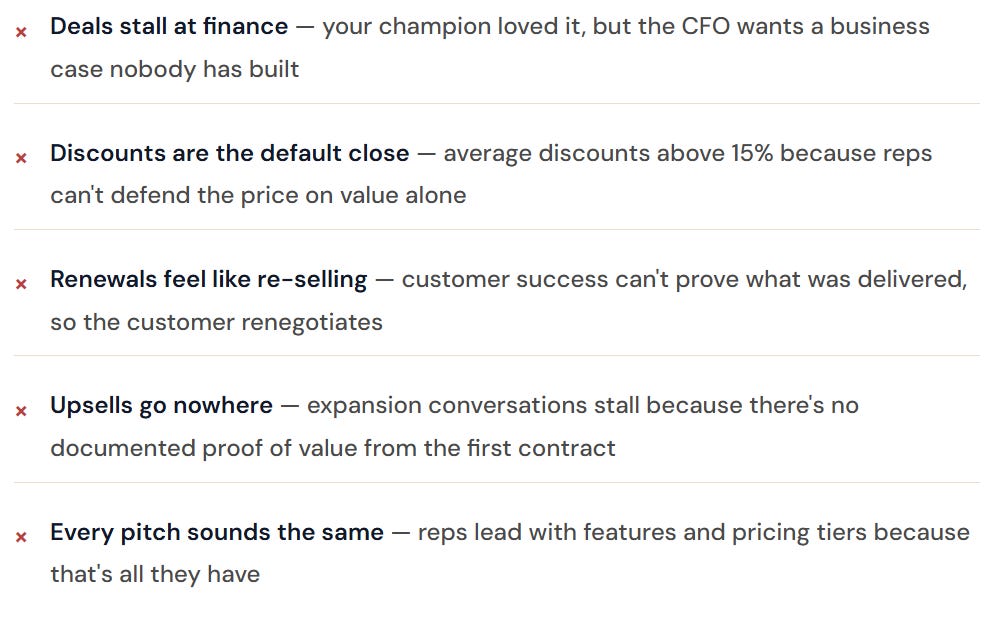
Sound familiar? Here's how it shows up across your team:
- ×
- Deals stall at finance — your champion loved it, but the CFO wants a business case nobody has built
- ×
- Discounts are the default close — average discounts above 15% because reps can't defend the price on value alone
- ×
- Renewals feel like re-selling — customer success can't prove what was delivered, so the customer renegotiates
- ×
- Upsells go nowhere — expansion conversations stall because there's no documented proof of value from the first contract
- ×
- Every pitch sounds the same — reps lead with features and pricing tiers because that's all they have
The fix isn't a new script or another training day. It's building a clear, repeatable system for articulating, delivering, and proving your value — before, during, and after the sale.
What a value model actually is (and isn't)
A value model is not a deck. It's not a case study. It's not a ROI calculator your marketing team built once and nobody uses.
It's a simple, structured answer to one question: what is it specifically worth to this customer to use your product instead of their next best alternative? In dollars. For their business. Based on their actual numbers.
When your reps have that answer — and can walk a prospect through it — everything changes. The conversation shifts from "can you do 20% off?" to "here's what staying on your current solution is costing you every quarter." The CFO meeting goes from ambush to alignment. The renewal goes from negotiation to formality.
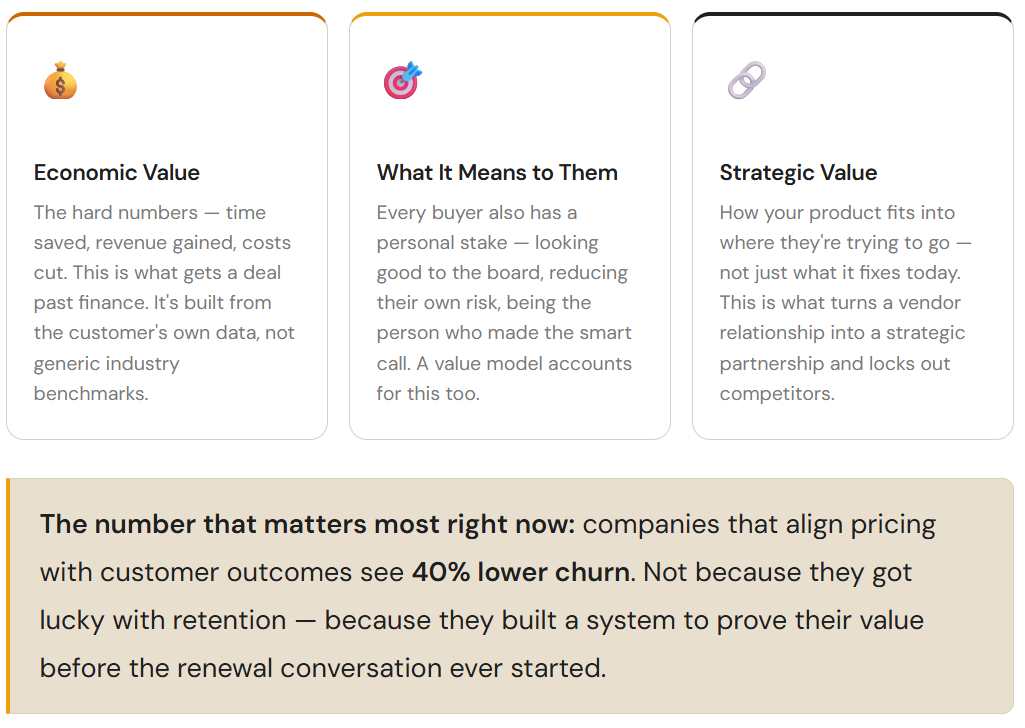
A complete value model covers three things:
💰
Economic Value
The hard numbers — time saved, revenue gained, costs cut. This is what gets a deal past finance. It's built from the customer's own data, not generic industry benchmarks.
🎯
What It Means to Them
Every buyer also has a personal stake — looking good to the board, reducing their own risk, being the person who made the smart call. A value model accounts for this too.
🔗
Strategic Value
How your product fits into where they're trying to go — not just what it fixes today. This is what turns a vendor relationship into a strategic partnership and locks out competitors.
The number that matters most right now: companies that align pricing with customer outcomes see 40% lower churn. Not because they got lucky with retention — because they built a system to prove their value before the renewal conversation ever started.
Where most sales teams break down
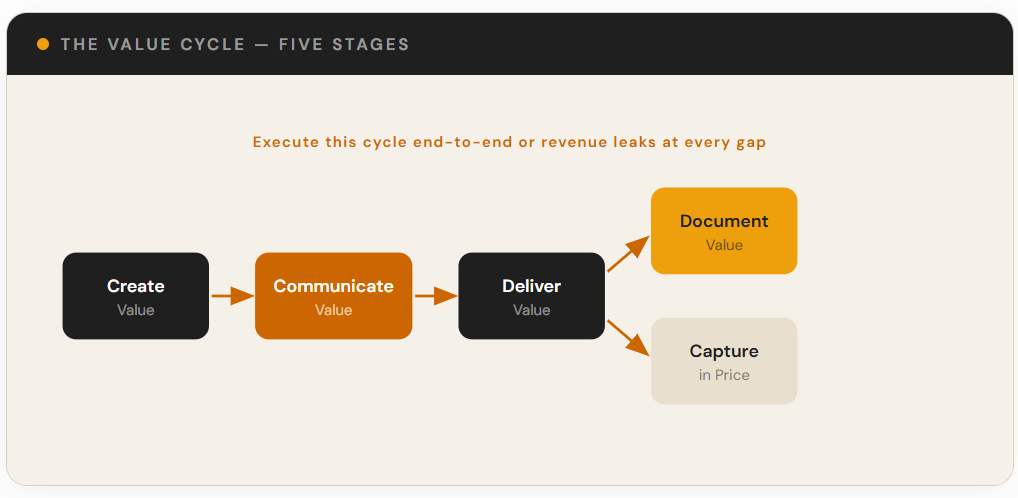
Most sales teams do one part of this well. They communicate value in the pitch. But they never build it into the rest of the motion — and that's where the revenue leaks.
The Value Cycle — Five Stages
Execute this cycle end-to-end or revenue leaks at every gapCreateValueCommunicateValueDeliverValueDocumentValueCapturein Price
Think about your last five deals that went sideways. Chances are the break happened at one of these points:
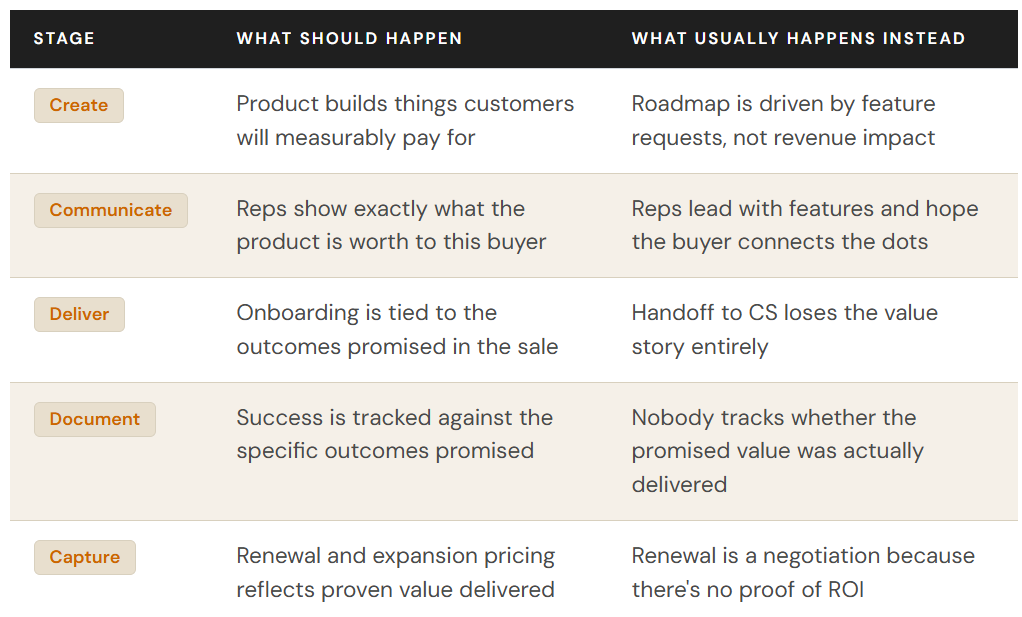
StageWhat should happenWhat usually happens insteadCreateProduct builds things customers will measurably pay forRoadmap is driven by feature requests, not revenue impactCommunicateReps show exactly what the product is worth to this buyerReps lead with features and hope the buyer connects the dotsDeliverOnboarding is tied to the outcomes promised in the saleHandoff to CS loses the value story entirelyDocumentSuccess is tracked against the specific outcomes promisedNobody tracks whether the promised value was actually deliveredCaptureRenewal and expansion pricing reflects proven value deliveredRenewal is a negotiation because there's no proof of ROIMost teams are solid at "Communicate." The rest of the cycle is where revenue quietly leaks — and where a value model closes the gaps.
How to actually build your value model
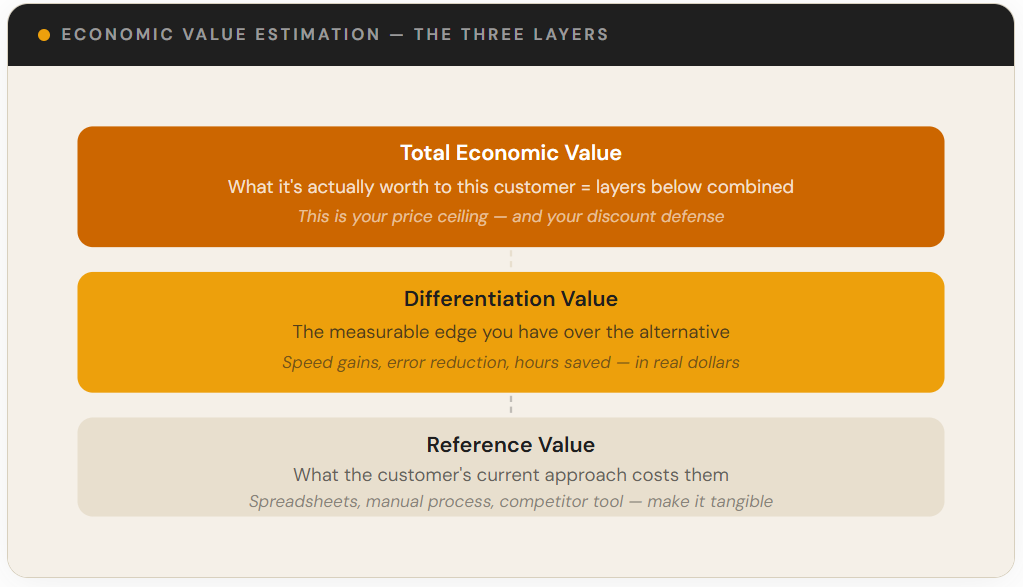
The good news: you don't need a team of economists. You need three things — a clear picture of what your best alternative costs customers, a documented list of what makes you measurably better, and the customer's own numbers to put against it.
Economic Value Estimation — The Three Layers
Total Economic ValueWhat it's actually worth to this customer = layers below combinedThis is your price ceiling — and your discount defense Differentiation ValueThe measurable edge you have over the alternativeSpeed gains, error reduction, hours saved — in real dollars Reference ValueWhat the customer's current approach costs themSpreadsheets, manual process, competitor tool — make it tangible
Once your reps can walk through this with a customer's real numbers — not hypotheticals — the CFO conversation flips. Instead of "justify your price," it becomes "show me the cost of not doing this." That's a completely different negotiation.
What changes when your team sells on value
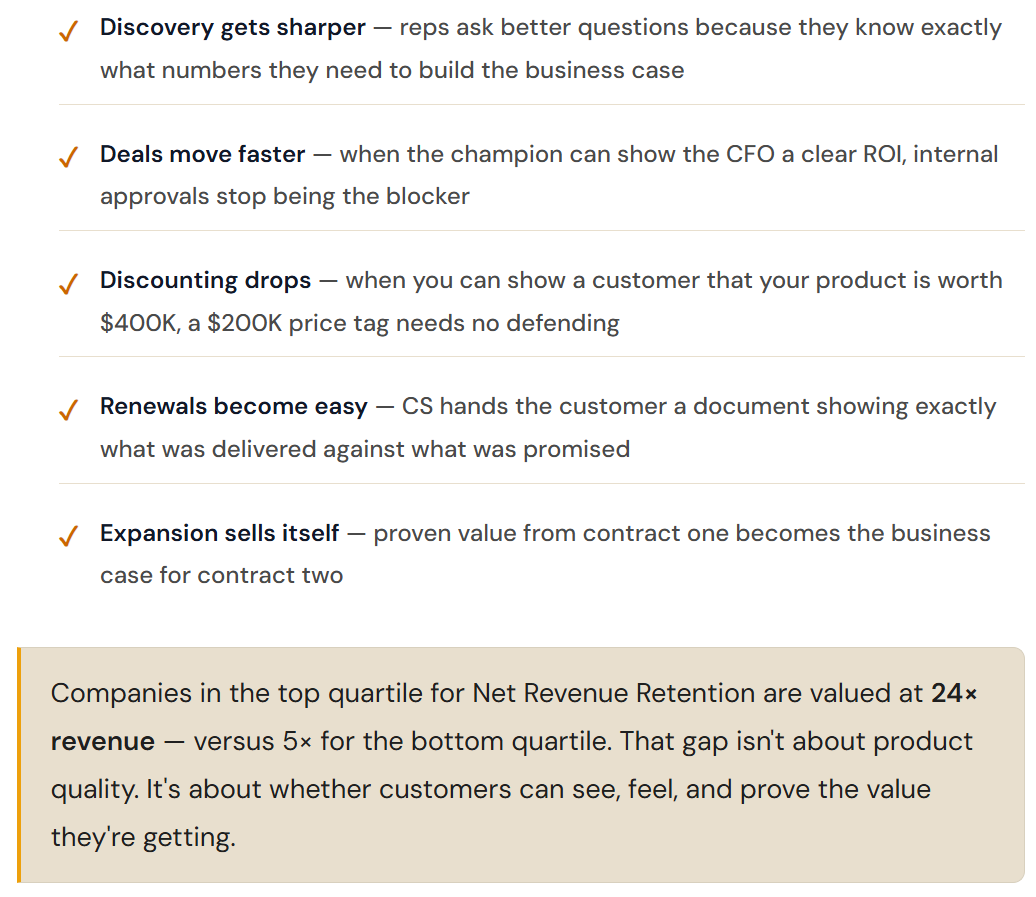
This isn't theoretical. Here's what actually shifts in your sales motion when you have a working value model:
- ✓
- Discovery gets sharper — reps ask better questions because they know exactly what numbers they need to build the business case
- ✓
- Deals move faster — when the champion can show the CFO a clear ROI, internal approvals stop being the blocker
- ✓
- Discounting drops — when you can show a customer that your product is worth $400K, a $200K price tag needs no defending
- ✓
- Renewals become easy — CS hands the customer a document showing exactly what was delivered against what was promised
- ✓
- Expansion sells itself — proven value from contract one becomes the business case for contract two
Companies in the top quartile for Net Revenue Retention are valued at 24× revenue — versus 5× for the bottom quartile. That gap isn't about product quality. It's about whether customers can see, feel, and prove the value they're getting.
How valueIQ makes this repeatable for your whole team
The hardest part of value selling isn't convincing one rep to do it differently. It's making it the default motion across 30, 50, or 150 reps — consistently, in every deal, without adding three hours of prep work per opportunity.
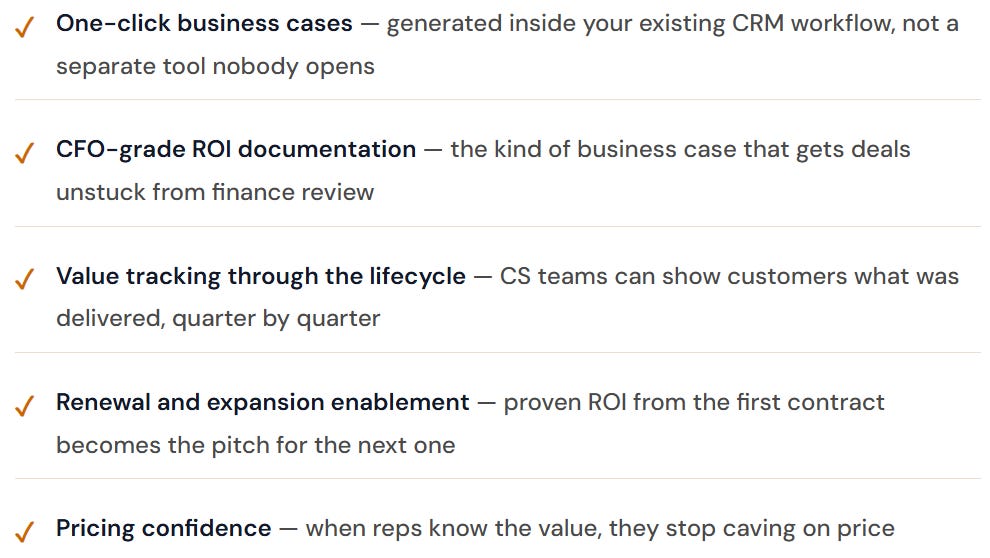
That's what valueIQ is built for. It gives every rep a live value model for each opportunity — built from the customer's own data, ready for the CFO conversation, and tracked through to renewal.
- ✓
- One-click business cases — generated inside your existing workflow, not a separate tool nobody opens
- ✓
- CFO-grade ROI documentation — the kind of business case that gets deals unstuck from finance review
- ✓
- Value tracking through the lifecycle — CS teams can show customers what was delivered, quarter by quarter
- ✓
- Renewal and expansion enablement — proven ROI from the first contract becomes the pitch for the next one
- ✓
- Pricing confidence — when reps know the value, they stop caving on price
The result: higher win rates, less discounting, stronger NRR, and a sales team that talks about outcomes instead of features. In a market where the median SaaS company spends $2.00 to acquire every $1.00 of new ARR, that's not a nice-to-have. It's how you survive the next two years.
Stop leaving money on the table
See how valueIQ gives your reps the value model they need to win deals, defend price, and turn renewals into a formality — not a fight.
Build Your First Value Model for Free
Continue Reading
The Customer Journey Is Your Guide to Value Communication
Value-Based Pricing 2.0 Goes Beyond Ringing the Sales Bell
What Is Your Target Value Ratio?
Value Paths Are the Key to Usage-Based Pricing
Stay ahead in value-based pricing
Get insights on pricing strategy, value selling, and customer value management — delivered to your inbox.
No spam. Unsubscribe anytime.